The Huntsman Bit
PERIMETER-REFERENCED CUTTING
Enlarge Existing Cutouts — With Precision
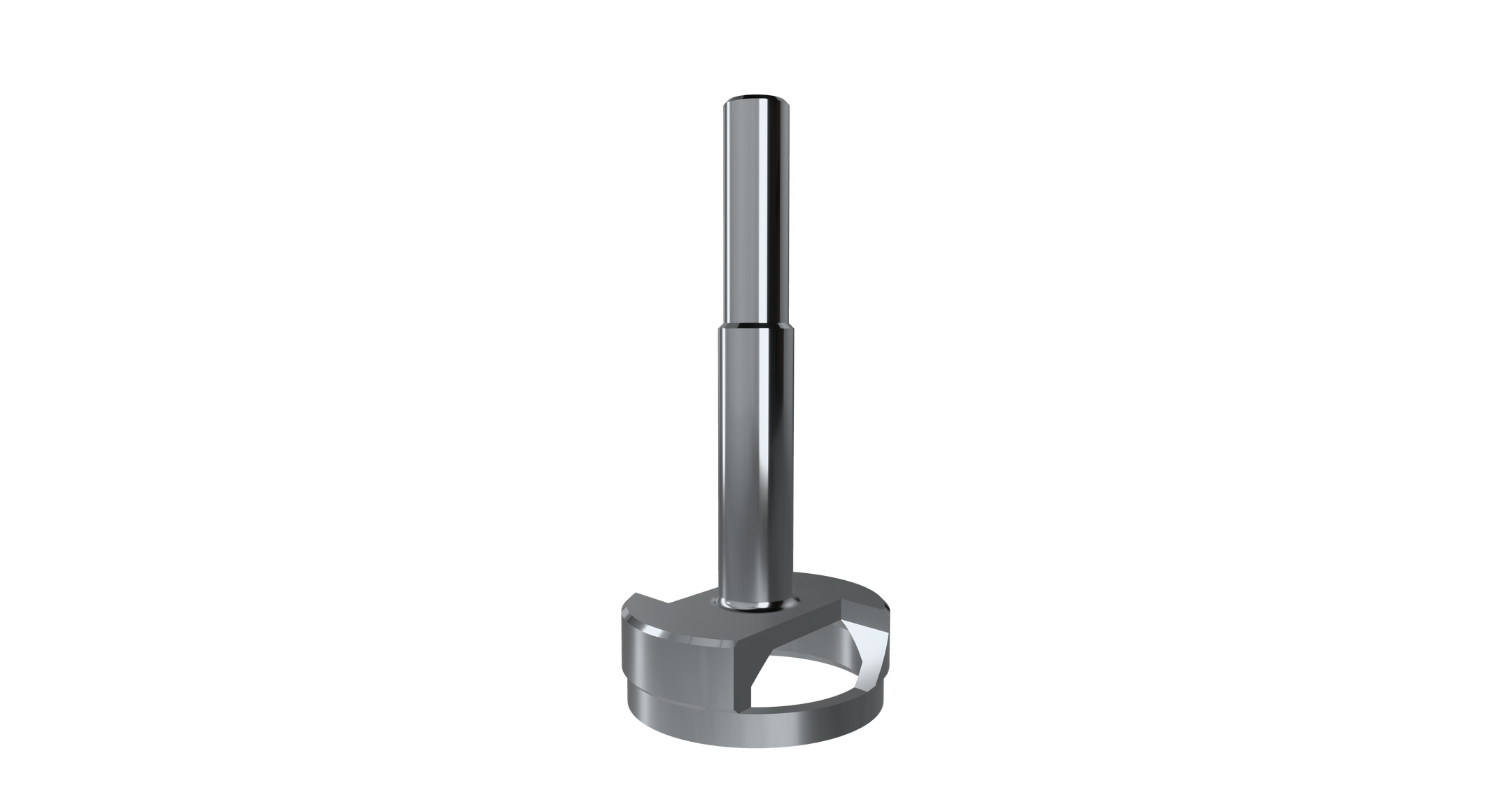
A purpose-built Forstner-style drill bit engineered to accurately enlarge existing circular cutouts after the original center point of reference has been lost. Designed to maintain concentric alignment and material integrity, the Huntsman Bit provides controlled, precise engagement to allow diameter step-up without disturbing the original termination plane.
REFERENCE
Bore-Guided Entry
The non-cutting leading edge references the existing cutout perimeter before the cutting edge engages, restoring a stable point of reference.
ALIGNMENT
Concentric Axis Retention
Engagement occurs concentrically, maintaining the original axis of the cut through diameter step-up.
PROGRESSION
Step-Style Advancement
The cutting profile enables controlled diameter increase in defined increments, allowing measured transition from the existing cut to the intended size.
INTEGRITY
Preserved End Plane
Diameter step-up occurs without advancing beyond the original planar endpoint, maintaining the established depth of cut.
CURRENT LIMITATIONS
Enlargement Introduces Compromises
When an existing cutout no longer contains its original center point of reference, the cutting dynamics change. Conventional enlargement methods may re-engage the bore, but they do so under altered support conditions — increasing the likelihood of axis deviation, bottom-plane intrusion, or reliance on secondary stabilization.
CENTERING
Loss of Reference
Initial cutout geometry is typically established through a center point of reference. Once removed, subsequent enlargement is no longer guided by that original point.
DEVIATION
Bore Axis Shift
Without the original point of establishment, cutting forces may redirect the tool path during re-entry, subtly shifting the bore axis from its initial position.
DEPTH
Base Plane Intrusion
Certain enlargement methods must advance beyond the established depth before the intended enlargement diameter fully engages, altering the flat bottom plane of the cutout.
PROCESS
Supplemental Corrective Measures
To counter these conditions, operators may resort to using jigs, plugs, or other improvised methods to regain control – adding variability and complexity to the process.
THE NEXT STEP
Reclaiming the Reference
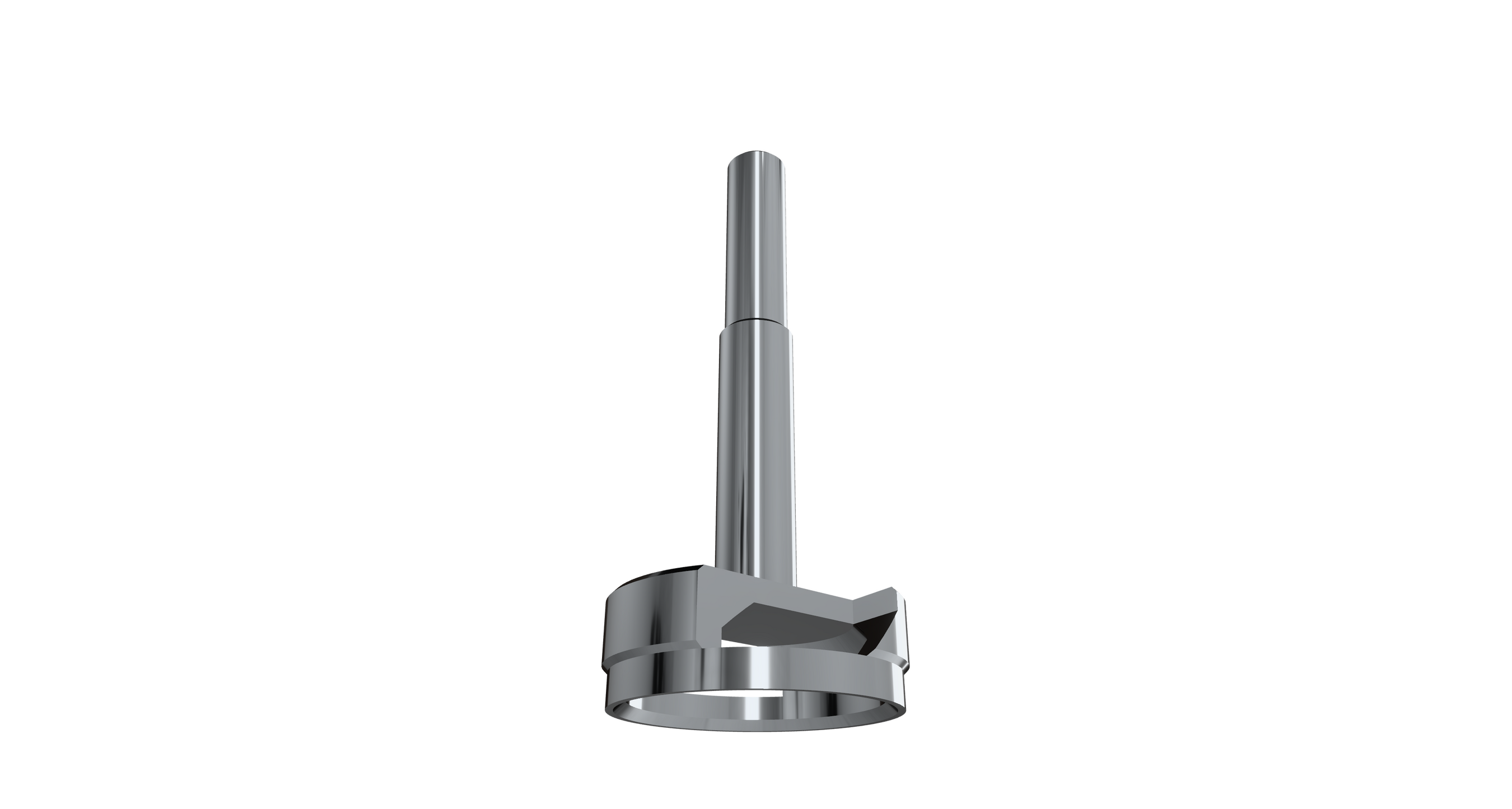
The Huntsman Bit locates and engages the existing bore perimeter to restore positional stability, ensuring accuracy without compromising the workpiece. This is achieved through a non-cutting leading edge that serves as a stabilizing guide into the existing cutout, followed by a cutting edge that enables precise diameter step-up.
GUIDE
Perimeter Pilot Geometry
The guide ring is dimensioned to index the existing cutout perimeter, establishing registration prior to material removal.
PROFILE
Radial Shearing Architecture
The cutting edge geometry employs positive rake to shear material cleanly rather than displace or crush it. Leading bevels guide material into the relief cavity while the adjoining support wall maintains radial stability throughout material removal.
STRUCTURE
Cylindrical Support Body
The vertical wall section maintains radial stability once full engagement is achieved, preserving roundness and resisting lateral deflection throughout material removal — preserving the controlled characteristics associated with Forstner-style drilling.
INTEGRATION
Unified Functional Design
Piloting, cutting, and stabilization functions are unified within a single design, eliminating reliance on auxiliary methods or secondary setups. Internal clearance features support chip evacuation and reduce rotational mass without altering functional intent.
MANUFACTURING CONSIDERATIONS
Designed for Familiar Production Methods
The Huntsman Bit is designed for compatibility with established Forstner bit manufacturing processes. Material selection, forming methods, and finishing operations align with conventional tool production workflows, permitting integration into existing production infrastructure.
MATERIAL
Conventional Tool Steels
The design utilizes readily available tool steels and alloys commonly employed in Forstner-style bit production, consistent with established supplier networks and material specifications.
PROCESS
Established Production Methods
The geometry is compatible with conventional machining, grinding, finishing, and heat-treatment operations used throughout the cutting tool industry, without necessitating process modification.
WORKFORCE
Standard Skill Requirements
Production can be executed within typical manufacturing environments by personnel of customary skill, without the need for specialized training or novel fabrication techniques.
SCALABILITY
Standardized Size Integration
The design supports common SAE and metric diameter increments consistent with existing Forstner sizing conventions. This alignment permits integration into established SKU structures and packaging formats without modification, contributing to a cost-effective manufacturing profile.
INDEPENDENT TECHNICAL AND LEGAL REVIEW
Documented Professional Opinions
Independent evaluations were conducted by a licensed professional engineer and a registered patent attorney to assess technical feasibility, manufacturability, and patentability. Excerpts from those formal assessments are presented below.
INDEPENDENT ENGINEERING ASSESSMENT
“Upon evaluation of the Huntsman Bit, it is my professional opinion that the new product idea is technically feasible as conceived.”
EXCERPT
James A. Bickford, P.E.
Registered Professional Engineer
— State of Pennsylvania
“The Huntsman Bit can be manufactured by existing metal finishing, sharpening, heat-treating, and associated mass production methods using readily available steel alloys.”
EXCERPT
REGISTERED PATENT COUNSEL OPINION
“In summary, I believe that your innovation teaches statutory subject matter, is novel, and is nonobvious in relation to the reviewed references.”
EXCERPT
John D. Gugliotta, Esq.
Registered Patent Attorney
“Differences in function, feature, and structure are significant enough to justify seeking utility patent protection.”
EXCERPT
THE FINAL STEP
Positioned for Partnership
The Huntsman Bit is technically validated, manufacturable using established processes, and protected by pending patent application. Manufacturers seeking structured licensing discussions are invited to make contact.
PATENT PENDING
Published U.S. Patent Application No. US-2025-0289065-A1
© 2026 Aether IP, LLC